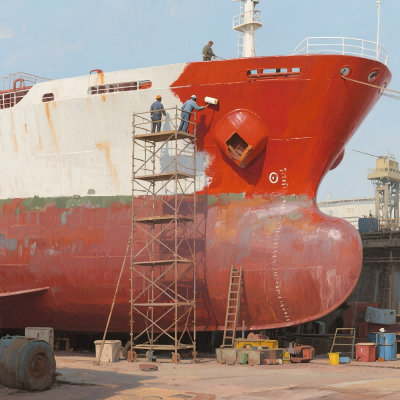
How Antifouling Coatings Address the Challenge of Marine Biofouling
Mar 30, 2026
The ocean is a world of extraordinary biodiversity, nurturing over 8,000 species of plants and 59,000 species of animals. Among them, approximately 600 species of fouling plants and 18,000 species of fouling animals will take the hull of a ship as their attachment target. These fouling organisms each have their own characteristics: barnacles possess hard calcareous shells with extremely strong adhesion, capable of firmly attaching even at a ship speed of 10 knots; oysters and mussels are mollusks that grow rapidly, and the organic acids they secrete can corrode the steel plate; sea squirts and bryozoans are colonial organisms that tend to form thick fouling layers on the hull; algae such as green algae and brown algae rely on photosynthesis for growth and are mainly distributed near the waterline; in addition, bacterial slime, secreted by bacteria and diatoms, represents the initial stage of the fouling process, creating conditions for the subsequent attachment of larger organisms.
The impact of these fouling organisms is far greater than one might imagine: with just 5% hull fouling, fuel consumption increases by 10%. When fouling reaches 50%, fuel consumption surges by over 40%. On a global scale, if the world's fleet had an average fouling level of 50%, an additional 7.06 billion tons of fuel would be burned each year, resulting in 210 million tons of excess carbon dioxide emissions. When a ship's hull becomes heavily encrusted with barnacles, oysters, and algae, it is like donning a suit of heavy armor—not only does sailing speed drop and fuel consumption soar, but even more troubling, the secretions from these organisms quietly corrode the steel, shortening the vessel's service life.
In the face of challenges posed by these "uninvited guests"—reduced speed, increased fuel consumption, and hull corrosion—humanity has never ceased its search for solutions. Today, we dive into the world of antifouling coatings on the hull, focusing on this unassuming layer of paint, to see how it has become a critical defense line in the struggle against marine organisms.
What is Antifouling Coating?
Antifouling coating is a specialized coating applied over the anti-corrosion primer on the hull. It works by continuously releasing antifouling agents, forming a thin layer containing active ingredients at the interface between the seawater and the coating, killing or repelling the larvae and spores of marine organisms that attempt to attach. Maintaining the effectiveness of antifouling coatings throughout a ship's docking cycle of approximately five years presents a significant technical challenge.
1. Characteristics of Antifouling Coatings
Antifouling effectiveness: Prevents marine organism attachment within a specified period
Antifouling agent leaching: Continuous and stable release into seawater
Water permeability: The coating film must have a certain degree of water permeability to maintain antifouling agent leaching
Interlayer adhesion: Good bonding with the anti-corrosion primer, with mutual solubility between coating layers
Resistance to seawater impact: No blistering or peeling during prolonged immersion
Self-polishing property (modern types): Gradual dissolution of the coating film during navigation, resulting in an increasingly smooth surface
2. Composition of Antifouling Coatings
Antifouling Agents: The core component, which must be slightly soluble in seawater and capable of killing or repelling marine organisms
Traditional: Cuprous oxide, organotin (TBT), mercury oxide (banned), DDT (phased out)
Modern: Copper pyrithione, zinc pyrithione, zineb, isothiazolone, etc. (low toxicity, environmentally friendly)
Binders/Resins: Control the leaching rate of antifouling agents
Soluble binders: Rosin (traditional), organotin copolymers (banned), acrylic copolymers (modern tin-free types)
Insoluble binders: Asphalt, chlorinated rubber, acrylic resins, etc.
Pigments: Improve mechanical properties and regulate leaching rate; commonly used are zinc oxide, iron oxide red, talc
Solvents and Additives: Thixotropic agents, anti-settling agents, stabilizers, etc.
3. Antifouling Mechanism: How to Drive Away Uninvited Guests?
The working mechanism of antifouling coating is as follows: when the coating film comes into contact with seawater, the antifouling agents (such as copper ions) gradually dissolve into the seawater, forming a thin active layer approximately ten to twenty microns thick on the coating surface, thereby repelling or killing the larvae and spores of marine organisms that attempt to attach.
The release rate of antifouling agents is measured by "leaching rate." Different antifouling agents require different leaching rates to remain effective: for copper ions, approximately 10 μg/(cm²·d); for organotin, only 1 to 2 μg/(cm²·d).
Control of the leaching rate is crucial—if the rate falls below the critical value, the antifouling effectiveness is lost; if it exceeds the critical value, it wastes the antifouling agents and shortens the coating's service life. Therefore, a high-performance antifouling coating must maintain a stable leaching rate slightly above the critical value throughout its service period, which can last several years.
Types of Antifouling Coatings: Five Generations from Traditional to Future
In response to the challenge of marine fouling, antifouling coatings have undergone multiple technological iterations over the past several decades. From early traditional antifouling coatings, to the revolutionary organotin self-polishing coatings, to today's mainstream tin-free self-polishing systems, and even to future-oriented low-surface-energy non-toxic coatings—each technological breakthrough represents a pursuit of a better balance among antifouling effectiveness, service life, and environmental safety. This path of technological evolution also reflects humanity's deepening understanding of marine environmental protection.
First Generation: Conventional Types (Soluble / Contact / Diffusion Types) Antifouling Agents
Soluble Type Antifouling Agents:Uses rosin as a soluble binder, with the entire paint film gradually dissolving in seawater, allowing antifouling agents to be continuously released.Disadvantages: High initial leaching rate, rapid decline in performance at later stages, and a service life of 1–3 years.
Contact Type Antifouling Agents:Uses an insoluble resin as the binder, with a very high content of antifouling agents (volume ≥ 52.4%). The particles are densely packed; as the surface layer dissolves, the inner agents are released through the voids.Service life: Can exceed 2 years.
Diffusion Type Antifouling Agents:Uses organotin compounds as antifouling agents (now phased out). Seawater penetrates the coating, causing it to swell, and the antifouling agents diffuse outward from the interior of the film.
Second Generation: Organotin Copolymer Self-Polishing (TBT-SPC) Antifouling Agents
Developed in the 1970s, this was a groundbreaking innovation in antifouling technology. The organotin copolymer serves both as the antifouling agent and the binder. In seawater, it undergoes hydrolysis, enabling a steady release of organotin while the paint film gradually dissolves. As a result, the surface becomes increasingly smooth—this is known as the “self-polishing” effect.
Advantages:
Stable leaching rate of antifouling agents, with a service life of up to 5 years
Self-smoothing film reduces drag and saves fuel
Resistant to alternating wet and dry conditions, suitable for use at the waterline
Easy maintenance, allowing direct overcoating
Fatal Drawback:Organotin compounds are highly toxic to non-target marine organisms. They have been shown to cause imposex in gastropods and deformities in oysters, and can enter the human body through the food chain. In 2001, the International Maritime Organization (IMO) adopted the International Convention on the Control of Harmful Anti-Fouling Systems on Ships (AFS Convention), which led to a global ban on organotin-based antifouling paints. A complete prohibition came into effect on January 1, 2008.
Third Generation: Tin-Free Self-Polishing Antifouling Coatings (Mainstream Today)
Developed as a replacement for TBT-based systems, these coatings mainly fall into three categories:
1. Hydration Type (CDP) Antifouling CoatingsUses rosin as a soluble binder, with hydrophobic resins controlling the release rate. The mechanism is as follows: rosin reacts with seawater to release biocides, while the surface hydrophobic resin forms a honeycomb-like structure. Under the scouring action of seawater, these structures break off, achieving “mechanical polishing.”Service life: Approximately 36 monthsFeatures: Lower cost, but forms a relatively thick leached (saponified) layer (~75 μm), requiring high-pressure freshwater washing during maintenance.
2. Hydrolysis Type (SPC) Antifouling CoatingsUses copper acrylate, zinc acrylate, or silyl acrylate copolymers as binders. These undergo hydrolysis or ion exchange in seawater, enabling a controlled and steady release of antifouling agents—achieving true “chemical polishing.”Features: Thin leached layer (~25 μm), excellent self-smoothing properties, and a service life of up to 60 months. Suitable for high-speed vessels (>20 knots).
Zinc Acrylate Type Antifouling Coatings:Polymer–COO–Zn–X + Na⁺ → Polymer–COO⁻Na⁺ + Zn²⁺ + X⁻
Silyl Acrylate Type Antifouling Coatings:Polymer–COO–SiR₃ + Na⁺ + Cl⁻ → Polymer–COO⁻Na⁺ + R₃SiCl
3. Hybrid Type Antifouling CoatingsCombines CDP and SPC technologies, with a high solids content (~60%). The leached layer is about 45 μm thick, offering a service life of 36–60 months at a moderate cost.
Fourth Generation: Low Surface Energy (Non-Toxic) Antifouling Coatings
This represents the most ideal antifouling approach: no release of any antifouling agents. By creating an ultra-low surface energy, the coating makes it difficult for marine organisms to attach, or prevents them from adhering firmly. Any attached organisms can be easily removed by water flow during vessel operation.
Mainstream Materials:
Silicone resins (polydimethylsiloxane, PDMS)
Fluorocarbon resins
Advantages:
Completely non-toxic and environmentally friendly
Antifouling service life of 5–10 years
Lower dry-docking and maintenance costs
Limitations:
Best suited for vessels operating at relatively high speeds (15–30 knots)
High cost
Complex application process
Relatively poor adhesion
Latest Developments:Fluorinated polysiloxanes (such as PNFHMS and PTFPMS), which combine the low surface energy of fluorocarbons with the high elasticity of silicone materials.
Latest Standard for Ship Bottom Antifouling Coatings: GB/T 6822—2024
In 2006, China merged and revised GB/T 13351—1992 General Technical Conditions for Ship Bottom Anti-Rust Paints and GB/T 6822—1986 General Technical Conditions for Ship Bottom Antifouling Paints into GB/T 6822—2008 Antifouling and Anti-Corrosion Coating Systems for Ship Hulls.
The newly updated standard, GB/T 6822—2024, specifies the following requirements for antifouling coatings:
Compatibility with Anti-Corrosion Coatings:Includes shallow sea immersion tests, dynamic simulation tests, and cathodic protection compatibility tests.
Antifouling Performance:Evaluated through shallow sea immersion testing.
Toxicity Requirements:Must not contain asbestos or prohibited chemical substances.
Application Properties:Suitable for high-pressure airless spraying, air spraying, roller coating, and brush application.
Storage Stability:
After 1 year of natural storage or 30 days of accelerated storage, the coating must be able to be uniformly mixed within 5 minutes.
Future Development Trends: Environmentally Friendly, Long-Lasting, and Low Surface Energy
Advancement of Tin-Free Self-Polishing Coatings:Further optimization of copper/zinc/silyl acrylate copolymers to improve polishing stability and extend antifouling service life.
Copper-Free Antifouling Coatings:Reduce the use of cuprous oxide and develop low-copper or copper-free systems based primarily on organic antifouling agents.
Upgrading Low Surface Energy Coatings:Overcome the application challenges and poor adhesion of silicone-based coatings to expand their range of use.
Biobased Antifouling Agents:Extract natural antifouling substances from marine plants and animals, such as capsaicin and eucalyptus extracts.
Fiber Flocking Antifouling:Utilize micro-fiber structures to make it difficult for fouling organisms to attach.
Smart Monitoring Coatings:
Integrate sensors into coatings to provide real-time feedback on antifouling agent release status.
The development of marine antifouling coatings still faces multiple challenges. On one hand, a balance must be struck between antifouling effectiveness and ecological safety; on the other hand, it must adapt to variations in different marine environments, sailing speed conditions, and service cycles. From the rise and fall of organotin, to the emergence of tin-free self-polishing coatings, and the ongoing exploration of low-surface-energy coatings—each advancement represents a pursuit of more environmentally friendly and longer-lasting solutions. Therefore, future development directions will place greater emphasis on green environmental protection, high efficiency and longevity, as well as multifunctional integration—such as integrated coating systems that combine anti-corrosion, antifouling, and drag reduction properties.
Facing these multiple challenges in marine antifouling coatings—balancing ecological safety, environmental adaptability, and long-term performance—future technological breakthroughs rely on continuous innovation in core materials. China AAB Group stands at the forefront of the industry, offering a range of high-performance antifouling raw materials and solutions:
From Copper Acrylate Self-polishing Resin and Silyl Acrylate Self-polishing Resin (SPSi-A100), to high-efficiency antifouling agents such as Zinc Pyrithione (ZPT) , Copper Pyrithione Powder 98% (CPT-98) , and Copper Pyrithione Paste/Dispersion (CPT) , as well as the broad-spectrum fungicide DCOIT 98% —we are committed to providing stable quality and professional technical support, helping coating manufacturers develop high-performance antifouling coatings that combine environmental friendliness, long-lasting effectiveness, and multifunctional integration.
Whether you are focused on optimizing traditional systems or pioneering next-generation green antifouling technologies, China AAB Group is your trusted partner. Please contact us to learn more about our popular products and join us in advancing marine antifouling coatings toward a greener, more efficient, and smarter future.