
-
Leave a Message : info@aabindustrygroup.com
-
Phone : +86 13951823978
Search
What Are You Looking For?
Leave a Message : info@aabindustrygroup.com
Phone : +86 13951823978

Currently, there are only a few systematic studies comparing the coating performance of TGIC and HAA, two types of outdoor curing agents. In this study, the coatings made with different curing agents were tested using methods such as water boiling, high-temperature baking, solvent wiping, and accelerated weathering.
The results showed that when the same polyester resin was cured with TGIC and HAA respectively, the polyester-TGIC coating performed better in water boiling resistance and yellowing resistance under high-temperature baking. In contrast, the polyester-HAA coating showed better resistance to solvent wiping and better weathering performance
As a type of polymer material, the performance of thermosetting powder coating primarily depends on the structure and aggregation state of the resin used. The curing agent plays a key role in determining its aggregation state.
Triglycidyl isocyanurate (TGIC) and hydroxyalkylamide (HAA) are the two mainstream curing agents for outdoor thermosetting powder coatings. Powder coatings cured with TGIC typically achieve excellent light and heat stability, abrasion resistance, and outstanding weathering performance. As a result, TGIC has remained highly favored since its introduction.
However, as people's living standards have risen and environmental awareness has grown, TGIC has faced increasing scrutiny due to its inherent toxicity and the environmental harm caused during its manufacturing process. As early as 1998, Europe and Australia had already banned the use of TGIC.
As the most ideal alternative to TGIC, HAA has developed rapidly in the industry since its successful development. In 2003, it officially replaced TGIC to become the world's largest curing agent for weather-resistant powder coatings. Except for a few properties where it does not perform as well as TGIC-cured powder coatings, the overall performance of powder coatings cured with HAA is comparable to that of TGIC-cured systems.
This study focuses on the aging performance of outdoor powder coatings. Powder coatings were prepared using TGIC and HAA respectively, and the advantages and disadvantages of each in terms of aging performance were compared and investigated.
1. Experimental Section
1.1 Experimental Raw Materials
Super weather-resistant polyester resin (hereinafter referred to as polyester); curing agent TGIC; curing agent HAA; titanium dioxide; barium sulfate; leveling agent; benzoin; gloss enhancer.
1.2 Powder Coating Preparation
|
Table 1 Formulation of Powder Coatings |
||
|
Raw Material |
TGIC-type Coating Formulation /g |
HAA-type Coating Formulation /g |
|
Polyester Resin |
279 |
285 |
|
TGIC/HAA |
21 |
15 |
|
Titanium Dioxide (TiO₂) |
102 |
102 |
|
Barium Sulfate (BaSO₄) |
90 |
90 |
|
Leveling Agent |
4 |
4 |
|
Benzoin |
2 |
2 |
|
Brightener |
— |
2.2 |
Powder coatings were prepared according to the basic formulation shown in Table 1. The process steps were as follows: batching → premixing → extrusion → tableting → grinding → sieving → finished product. The prepared powder coatings were applied by electrostatic spraying and then cured at 200°C for 10 minutes to obtain the powder coatings.
1.3 Experimental Testing and Conditions
1.3.1 Isothermal Curing Test
Isothermal curing tests of the powder coatings were conducted using differential scanning calorimetry (DSC). The test conditions were as follows: N₂ as protective gas at a flow rate of 50 mL/min; heating rate of 300 K/min, rapidly heating to 200°C and holding for 20 min.
1.3.2 Water Boiling Test
Water boiling tests were carried out using a sterilizing pressure cooker with deionized water at 120°C. After the water boiling test, the coating surface was wiped dry, and the color difference and gloss were measured.
1.3.3 Water Absorption Rate Test
The water absorption rate of the coating was calculated based on the mass difference before and after water absorption. The mass of the coating after vacuum drying was recorded as m₁, and the mass after immersion in water or boiling, with the surface wiped dry with paper, was recorded as m₂. The water absorption rate ω = [(m₂ − m₁)/m₁] × 100%.
1.3.4 Baking Test
Baking tests were conducted using a forced-air oven, with a baking time of 2 hours. After baking, the color difference and gloss of the coating were measured.
1.3.5 Solvent Wiping Test
The powder coating was sprayed onto an aluminum substrate and cured at 200°C for 10 minutes. A methyl ethyl ketone (MEK) instrument wiping test was performed, with a load of 1000 g on the test panel and a wiping frequency of 50 times per minute. The number of wipes required to expose the substrate was recorded. Each coating thickness was wiped three times, and the average of the three results was taken.
1.3.6 Accelerated Artificial Weathering Test
Accelerated artificial weathering tests were conducted using a QUV-313 tester. The test conditions were as follows: irradiance of 0.71 W/m², 4 hours of light exposure at 60°C, followed by 4 hours of condensation at 50°C. After the test, the color difference and gloss of the coating surface were measured.
1.3.7 Coating Thickness Test
The coating thickness test was carried out in accordance with GB/T 4957.
1.3.8 Coating Gloss Test
The coating gloss test was carried out in accordance with GB/T 9754, measured at a 60° incident angle.
1.3.9 Coating Color Difference Test
The coating color difference test was carried out in accordance with GB/T 11186.2 and GB/T 11186.3.
2. Results and Discussion
2.1 Isothermal Curing Test
Figure 1 shows the isothermal curing process curves of polyester-TGIC and polyester-HAA at 200°C.
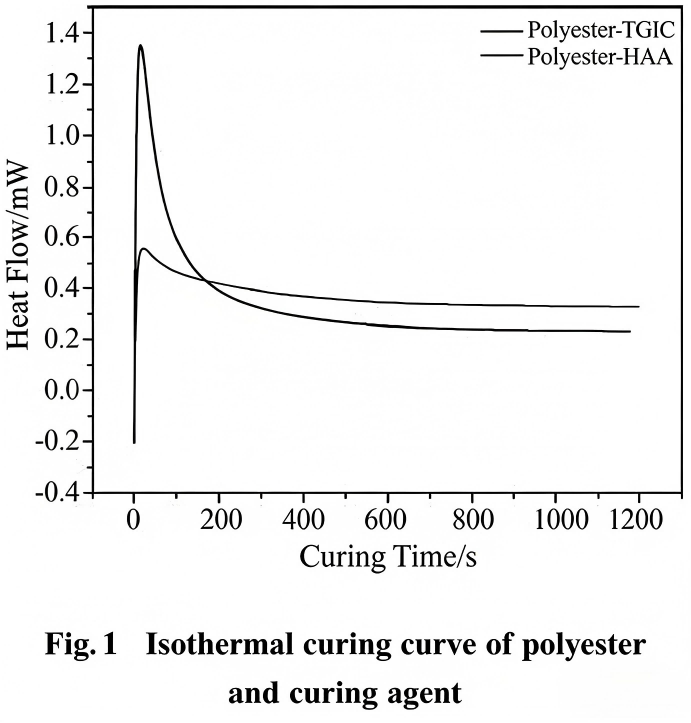
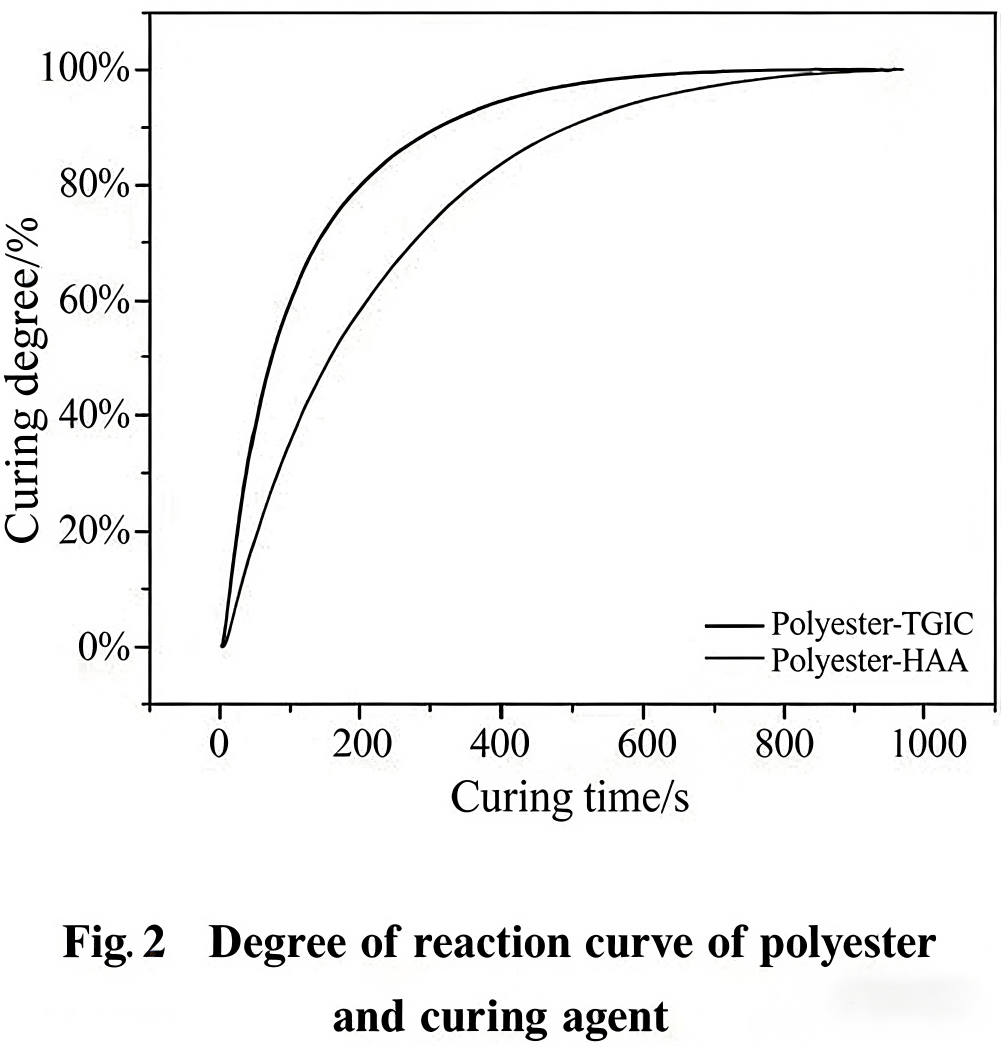
Figure 1 shows the isothermal curing process curves of polyester-TGIC and polyester-HAA at 200°C. The experimental results show that the time to reach the maximum reaction rate for polyester-TGIC during isothermal curing was 21 seconds, while for polyester-HAA it was 15 seconds. This indicates that the reaction between polyester and TGIC is faster. Meanwhile, as can be seen from the curing reaction degree curve (Figure 2), at 600 seconds, the reaction degree of polyester with TGIC reached 98.82%, while that of polyester with HAA reached 94.60%.
At 200°C, within the same period, the reaction between polyester and TGIC was faster and achieved a higher reaction degree compared to that between polyester and HAA. This may be due to the presence of a curing accelerator in the polyester that promotes the reaction with TGIC, while this accelerator shows no significant accelerating effect on the reaction between polyester and HAA.
Overall, under the curing condition of 200°C for 10 minutes, the difference in reaction degree between polyester-TGIC and polyester-HAA is relatively small, which has little effect on the overall performance differences of the coatings.
2.2 Water Resistance Test
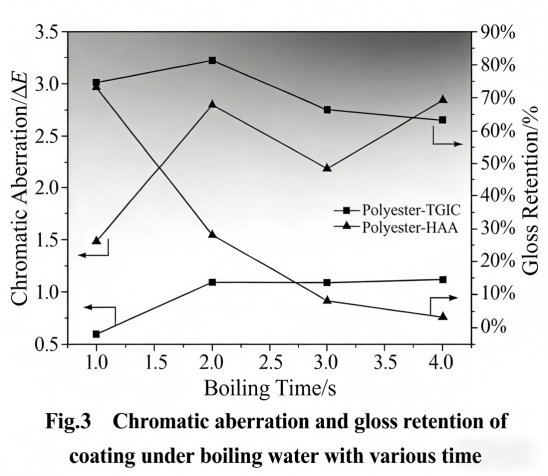
Figure 3 shows the changes in color difference and gloss retention of polyester-TGIC coating and polyester-HAA coating under different water boiling times.
As can be seen from Figure 3, with increasing water boiling time, the color difference of the coatings increased while the gloss retention decreased. It can also be observed that the changes in color difference and gloss retention of the polyester-HAA coating were greater than those of the polyester-TGIC coating. In particular, the gloss retention of the polyester-HAA coating showed a sharp decline.
As water boiling time extended, the surface of the polyester-HAA coating exhibited severe loss of gloss and even chalking. This phenomenon may be attributed to the larger free volume of the polyester-HAA coating at 120°C, making it easier for water to penetrate into the coating and react with it during the water boiling process.
In addition, to compare the affinity between the coatings and water, the water absorption rates of the coatings were investigated under different conditions.
Table 2 shows the water absorption rates of the coatings at room temperature and after water boiling at 120°C for 2 hours. It can be seen that at room temperature, the water absorption rate of the polyester-TGIC coating was slightly higher than that of the polyester-HAA coating.
|
Table 2 Water absorption of coatingunder different conditions |
||
|
Coating |
Polyester-TGIC |
Polyester-HAA |
|
Water absorption (room temperature (~30℃)) |
1.53% |
0.86% |
|
Water absorption(120℃/2h) |
9.54% |
31.2% |
After water boiling at 120°C for 2 hours, the water absorption rates of both coatings changed significantly compared to those at room temperature. After water boiling, the water absorption rate of the polyester-HAA coating increased sharply and was much higher than that of the polyester-TGIC coating.
The factors causing the changes in water absorption under different conditions may be due to the fact that at room temperature, the coating structure remains dense, making it difficult for water to adsorb and penetrate into the coating, resulting in relatively low water absorption rates for both coatings. However, under water boiling conditions at 120°C, the coating structure undergoes significant changes, allowing a large amount of water to enter the coating interior, leading to a sharp increase in water absorption.
For polymers, below the glass transition temperature, the internal structure exhibits rigid "voids"; above the glass transition temperature, the internal structure exhibits flexible "free volume."
The difference in water absorption between the polyester-TGIC coating and the polyester-HAA coating at 120°C may be due to the greater flexibility of the polyester-HAA coating compared to the polyester-TGIC coating. The polyester-HAA coating has a larger free volume at 120°C, allowing it to accommodate more water.
2.3 Heat Resistance Test
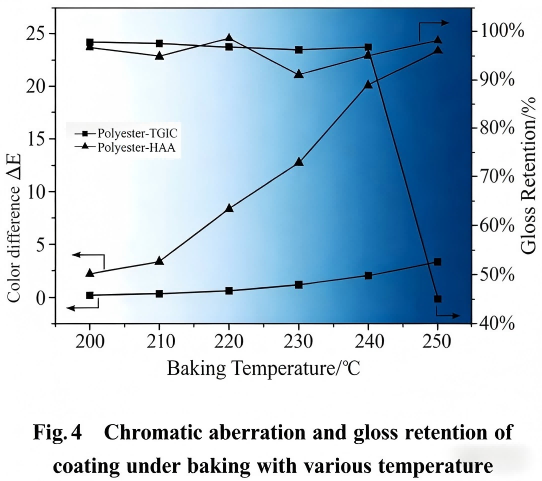
Figure 4 shows the changes in color difference and gloss retention of the polyester-TGIC coating and polyester-HAA coating after baking at different temperatures.
It can be observed that as the baking temperature increased, the color difference of both coatings increased, and the color difference change of the polyester-HAA coating was significantly greater than that of the polyester-TGIC coating.
This is mainly due to the presence of nitrogen elements in HAA itself and during its production process, which are prone to discoloration, as well as nitrogen-containing impurities remaining from the HAA manufacturing process. Under high-temperature conditions, a series of reactions occur, generating chromophoric groups that cause yellowing.
During the baking process, the gloss retention of the polyester-TGIC coating remained unchanged initially, then showed a sharp decline at 250°C. This was mainly due to secondary melting of the coating at 250°C, resulting in severe orange peel on the coating surface. In contrast, the gloss retention of the polyester-HAA coating remained unchanged or slightly increased under the same test conditions, mainly due to re-leveling of additives on the coating surface.
Comparing the experiments of polyester-TGIC and polyester-HAA coatings at different temperatures, it can be seen that the yellowing resistance of polyester-TGIC is far superior to that of polyester-HAA. However, at 250°C, the polyester-TGIC coating undergoes secondary melting, which severely compromises its normal use. Therefore, excessively high temperatures should also be avoided when using polyester-TGIC.
2.4 Solvent Resistance Test
|
Table 3 Solvent rubs for coating with different thickness |
||
|
Coating |
Polyester-TGIC |
Polyester-HAA |
|
Thickness (~45 μm) |
17 |
28 |
|
Thickness (~55 μm) |
33 |
38 |
|
Thickness (~65 μm) |
40 |
41 |
2.5 Accelerated Artificial Weathering Test
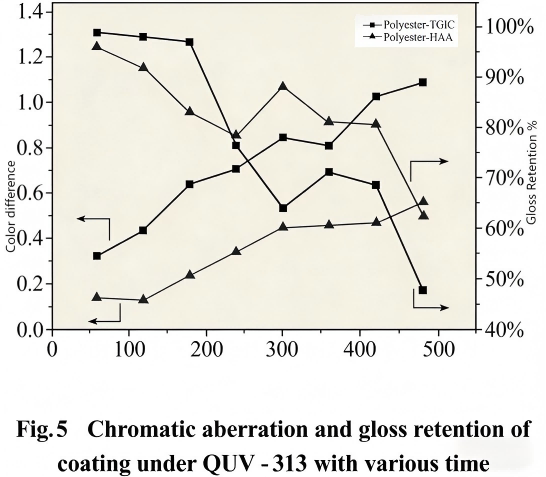
Figure 5 shows the test results of polyester-TGIC and polyester-HAA coatings under different aging times. It can be seen that as the aging time increases, the color difference of the polyester-TGIC coating gradually increases while the gloss retention gradually decreases. Similarly, the color difference of the polyester-HAA coating also gradually increases and the gloss retention gradually decreases.
It can also be observed that at the same aging time, the changes in color difference and gloss retention of the polyester-HAA coating are smaller than those of the polyester-TGIC coating. This indicates that the weathering resistance of the polyester-HAA coating is superior to that of the polyester-TGIC coating.
Conclusion
(1) When using TGIC and HAA to cure the same polyester resin respectively, the reaction between polyester and TGIC is faster than that between polyester and HAA.
(2) The polyester-TGIC coating exhibits better water boiling resistance and yellowing resistance under high-temperature baking compared to the polyester-HAA coating.
(3) The polyester-HAA coating exhibits better solvent wiping resistance and weathering resistance compared to the polyester-TGIC coating.



Hi! Click one of our members below to chat on